
Do Air Purifiers Really Work? What They Remove—and What They Don’t
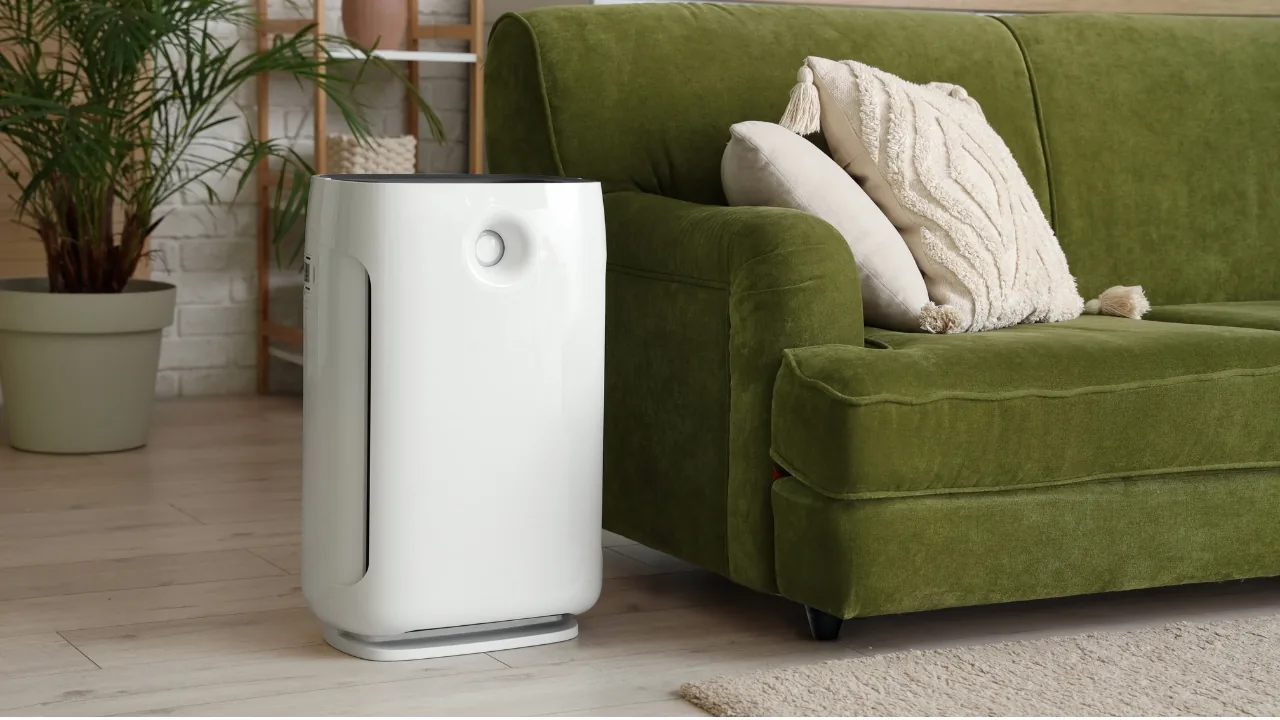
Do air purifiers work? Yes—a correctly sized purifier with an effective particle filter can reduce airborne particles such as PM2.5, pollen, dust, and smoke in a room. But it cannot remove every pollutant, replace ventilation, control humidity, repair mold, or make unsupported health promises true.
The practical question is not whether “air purifiers” work as one giant category. It is whether a specific machine moves enough air through the right filter for the pollutant, room, fan setting, and runtime. Filter efficiency matters. Clean-air delivery matters more.
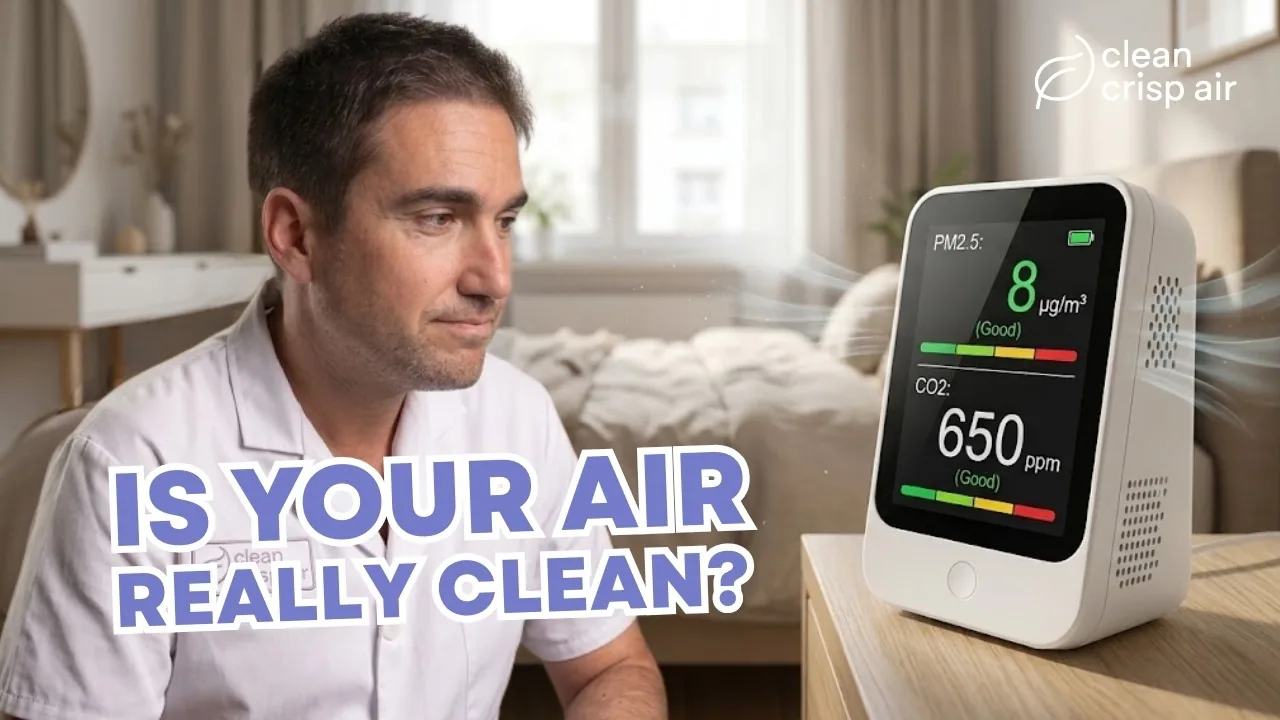
Prefer to watch? See the Clean Crisp Air explainer below, or watch Do Air Purifiers Really Work? We Tested PM2.5 for 60 Minutes on YouTube.
Do air purifiers really work? The short answer
Portable air purifiers can lower the concentration of pollutants their filters are designed to capture. A particle purifier can reduce airborne particles. A purifier with substantial activated carbon may reduce certain gases and odors. Neither technology removes everything.
The US Environmental Protection Agency’s Guide to Air Cleaners in the Home says source control and ventilation with clean outdoor air are the most effective ways to improve indoor air. Filtration is a supplement—not permission to keep generating pollution and hope a fan catches it later.
- Purifiers are most useful when airborne particles are the measured problem, the unit is sized for the room, and it runs long enough at an effective speed.
- Purifiers are less useful when the pollutant is a gas the filter cannot adsorb, the fan setting is too low, the filter is overloaded, or the room is much larger than the rating.
- Purifiers are the wrong tool for accumulated CO2, excessive humidity, radon, carbon monoxide, active water intrusion, or removing a mold source.
How does an air purifier work?
A portable purifier pulls room air through one or more treatment stages and returns the processed air to the room. Its performance depends on how efficiently it captures the target pollutant and how much treated air it delivers over time.
Mechanical particle filtration
Pleated filters capture airborne particles as air passes through their fibers. The smallest particles do not simply fall through holes like pasta through a colander; interception, impaction, and diffusion all contribute to capture.
The EPA defines HEPA as a pleated mechanical filter that can theoretically remove at least 99.97% of airborne particles at 0.3 microns. That figure describes air passing through the filter under defined conditions. It does not mean a portable machine removes 99.97% of every particle from an entire room in one pass—or that the room stays clean while new particles keep entering.
Activated carbon and gas filtration
Activated carbon and other sorbent media can capture some gases and odors. Performance depends on the chemical, the amount and type of media, contact time, airflow, humidity, and whether the material is already saturated. A thin black sheet beside a HEPA filter should not be marketed as universal protection from VOCs.
For a deeper explanation, see our guide to which odors activated carbon may help reduce. Source removal and appropriate ventilation remain the first response for many gas and odor problems.
Ionizers and ozone-producing devices
Electronic air cleaners may charge particles, collect them on plates, or cause them to settle on nearby surfaces. Some technologies can emit ozone. The EPA warns that ozone is a lung irritant and says no federal agency has approved ozone generators for occupied spaces.
The California Air Resources Board’s certified-device list can help check ozone-emission compliance for products sold in California. CARB is explicit that certification is not proof that a purifier effectively removes pollutants or is universally “safe”; it addresses regulatory requirements including ozone emissions.
What do air purifiers remove?
PM2.5 and smoke particles
A well-sized particle purifier can reduce PM2.5 from cooking, outdoor smoke, combustion, and other particle sources. Results depend on room volume, clean-air delivery rate, fan speed, placement, filter condition, doors, windows, HVAC operation, and the rate at which new pollution enters.
Remove or stop the source first when it is safe. Use a vented range hood during cooking, avoid indoor smoking and candles, and reduce outdoor smoke entry during poor-air events. A purifier can accelerate particle removal; it cannot make ongoing smoke generation harmless.
Pollen, dust, pet dander, and airborne mold particles
Particle filters can capture airborne pollen, dust, pet dander, and some particles released by mold. They do not remove material already settled on surfaces, eliminate the source, or guarantee symptom improvement. Cleaning, source control, moisture control, and appropriate filtration work together.
Some gases and odors—with the right media
Substantial activated carbon or another gas-specific sorbent may reduce selected gases and odors. Particle CADR does not rate gas removal, and a purifier that performs well against smoke particles may perform poorly against a vapor. Check exact manufacturer test data for the target chemical rather than trusting an “all odors” badge.
What air purifiers cannot remove or fix
- Carbon dioxide: Ordinary portable purifiers recirculate room air. They do not provide the outdoor-air exchange needed to lower accumulated CO2.
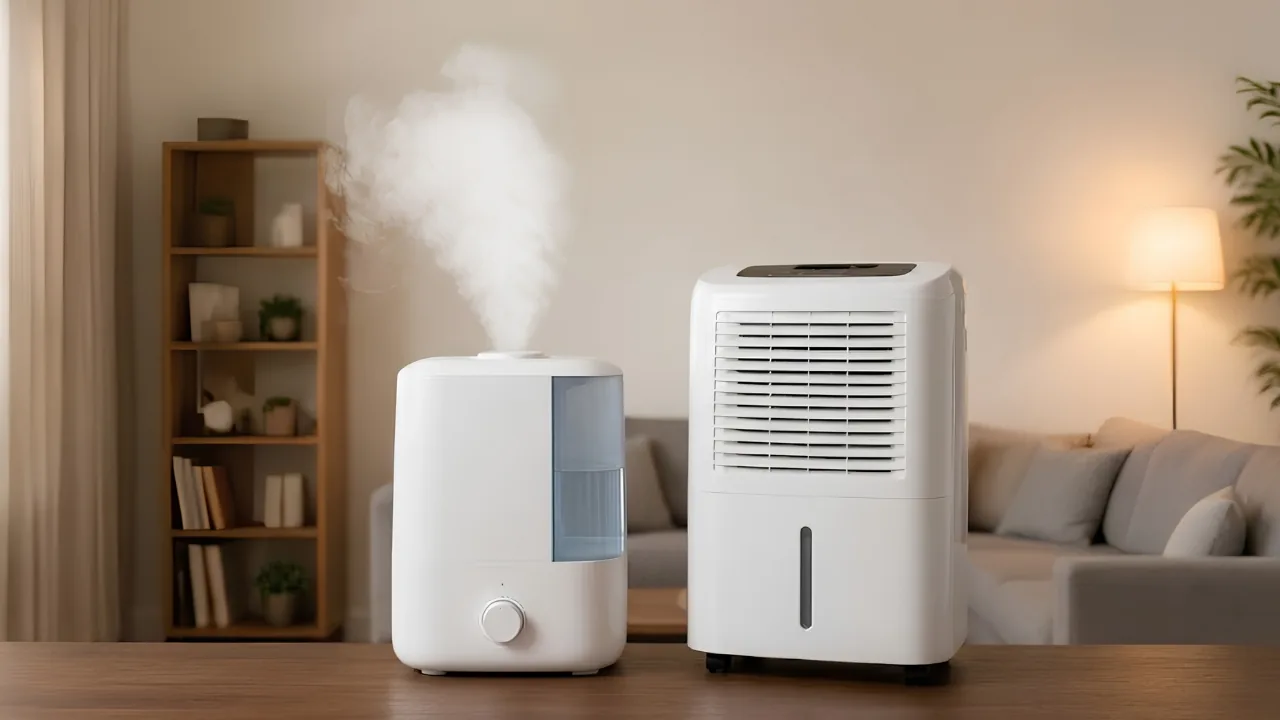
- Humidity: A purifier is neither a humidifier nor dehumidifier. Use moisture control for RH problems.
- Radon: Use a radon-specific test and qualified mitigation when needed.
- Carbon monoxide: Use properly installed certified CO alarms. If one sounds, leave and follow emergency guidance.
- Active mold: A purifier may capture some airborne particles, but it does not repair moisture damage or remove contaminated material.
- Settled dust: Filtration affects material suspended in air. Dust already on surfaces still requires safe cleaning and source reduction.
- Every VOC or odor: Gas removal depends on chemistry and adequate sorbent capacity. A particle filter cannot capture gases.
This distinction matters overnight. In our seven-night bedroom-air guide, PM2.5 can improve while CO2 continues rising in a closed occupied room. The purifier may be working perfectly at the particle job while ventilation remains inadequate.
HEPA efficiency versus real room performance
HEPA efficiency is a property of the filter. Whole-room cleaning depends on the complete machine and the conditions around it. A high-efficiency filter attached to a weak fan, obstructed intake, leaking housing, or undersized unit can clean the room slowly.
Think in two parts:
- Capture efficiency: What fraction of target particles is removed from air passing through the filter?
- Airflow: How much room air passes through the purifier each minute?
Clean air delivery rate, or CADR, combines particle removal and airflow into a more useful room-performance metric. Higher CADR means the machine delivers more particle-cleaned air per minute under the test condition.
How to choose CADR for your room
The EPA recommends choosing a particle CADR large enough for the room. Its sizing examples use approximately 65 cubic feet per minute of CADR for each 100 square feet of floor area with an eight-foot ceiling. Higher ceilings, open plans, rapid sources, smoke conditions, or a quieter operating speed may justify more capacity.
- Measure the room’s length and width.
- Multiply them to get square feet.
- Check the purifier’s smoke CADR, which represents smaller particles.
- Compare that CADR with the room size rather than a vague “up to” claim.
- Remember that CADR is generally measured at the highest fan speed.
If a purifier advertises a huge room based on one air change per hour, it may technically process that volume while cleaning too slowly for a real particle event. Compare CADR and intended air changes, not headline square footage alone.
Central HVAC filtration is a separate option. Our MERV ratings guide explains why the highest number is not automatically compatible with every system and why filter fit, pressure drop, and fan operation matter.
How to test whether an air purifier works in your room
A useful household test compares the decay of PM2.5 under documented conditions. It does not deliberately create dangerous smoke and does not pretend to be a laboratory certification.
Record the setup
- purifier make, model, claimed CADR, filter type, and filter age;
- room length, width, ceiling height, and open connections to other rooms;
- fan setting, placement, and distance from obstructions;
- PM2.5 monitor model, placement, and stabilization time;
- outdoor AQI, doors, windows, HVAC status, occupancy, and weather;
- the ordinary particle event, such as normal cooking, without intentionally burning food.
Place the monitor in representative room air—not beside the purifier outlet or directly above the stove. Use our home air-quality testing protocol for sensor placement, context logging, and the limits of consumer monitors.
Run comparable purifier-off and purifier-on trials
- On the first comparable day, record the PM2.5 peak after the ordinary source stops, then track natural decay for 60 minutes with the purifier off.
- On another comparable day, use the same activity, room, monitor position, and HVAC setup as closely as practical.
- Start the purifier at a defined fan setting after the source stops.
- Record PM2.5 at consistent intervals for 60 minutes.
- Compare starting concentration, peak, time to fall by half, and the 60-minute reading.
- Label differences in cooking intensity, outdoor air, HVAC cycles, occupancy, doors, or windows.
The companion video demonstrates the comparison. The raw monitor export was not supplied with this article draft, so this page does not invent a dramatic percentage reduction. Insert the verified chart and numerical findings only after the dataset is available and checked.
How to interpret the result without fooling yourself
A steeper PM2.5 decline during the purifier-on trial supports the conclusion that the setup improved particle removal under those conditions. It does not prove the purifier removes CO2, every gas, allergens already settled on furniture, or the health risk from every exposure.
Watch for these traps:
- Different starting levels: Compare decay rate and context, not only the final number.
- Outdoor-air changes: Open windows or changing outdoor PM can dominate the room trend.
- HVAC cycling: Central filtration and mixing may alter either trial.
- Sensor location: A monitor in the clean-air jet will exaggerate the speed of whole-room cleaning.
- Fan-speed mismatch: A published maximum CADR does not describe sleep mode.
- One successful hour: Filter loading, ongoing sources, and normal occupancy affect long-term performance.
Where should you place an air purifier?
Put the purifier in the room where the target pollutant and occupants are, with enough clearance for the intake and outlet. Do not hide it behind furniture, push an intake into a curtain, or aim the clean-air outlet directly at the monitor during a test.
Follow the manufacturer’s floor or tabletop instructions. There is no universal rule that every purifier must sit three feet above the floor. Design, intake location, stability, cord safety, room airflow, and the source all matter. Our existing guide discusses air-purifier placement on a table or floor; use the model manual as the final authority.
Filter replacement, noise, and operating cost
A purifier only helps when people run it. Noise that forces the fan onto an ineffective setting is a performance problem, not a lifestyle footnote. Compare CADR and noise at the speed you can tolerate.
Filters collect material and require inspection or replacement. Follow the exact manufacturer schedule and indicator rather than assuming every HEPA filter lasts the same number of months. Heavy smoke, renovation dust, pets, high runtime, and a polluted outdoor environment can shorten useful life. See our guide to air-purifier HEPA-filter replacement, then confirm the current manual for your model.
Estimate electricity with watts divided by 1,000, multiplied by operating hours and the local electricity rate. Include replacement filters in the ownership cost. A cheaper unit that is too noisy, undersized, or expensive to maintain can be worse value than a larger machine operated at a practical setting.
Are air purifiers worth the money?
An air purifier is more likely to be worth it when:
- monitoring or a known event shows airborne particles are a real problem;
- source control and suitable ventilation are already being used;
- the unit has sufficient CADR for the room and intended fan speed;
- replacement filters are available and affordable;
- the purifier can be positioned and operated consistently;
- the expected benefit is particle reduction—not a promise to solve every indoor-air issue.
It is more likely to waste money when the unit is dramatically undersized, the target is CO2 or humidity, the carbon media is too small for the gas claim, the filter is never replaced, or the machine is purchased instead of repairing the source.
Frequently asked questions
Do air purifiers remove dust?
They can reduce airborne dust particles that pass through the filter. They do not remove dust already settled on floors, shelves, bedding, or furniture, and they do not eliminate the source.
Do air purifiers remove smells?
A purifier with enough appropriate sorbent media may reduce some gases and odors. Particle filters alone do not remove gases. Remove the odor source and ventilate appropriately before relying on carbon.
Do air purifiers remove CO2?
No, standard portable purifiers do not remove accumulated carbon dioxide. Use outdoor-air ventilation or an appropriately designed mechanical ventilation system, considering outdoor air quality and building conditions.
Can an air purifier remove mold?
It may capture some airborne particles released by mold, but it cannot repair the moisture source or remove established growth from materials. Moisture correction and appropriate remediation come first.
Should an air purifier run all day?
Longer runtime generally filters more air, but follow the manufacturer’s safety instructions. Choose an effective fan setting, keep airflow clear, inspect filters, and consider noise and energy use.
Does a HEPA filter remove viruses?
HEPA filters can capture airborne particles across a range of sizes, including particles that may carry biological material. A purifier does not prevent every transmission route, eliminate exposure, or replace public-health guidance, ventilation, source control, and other appropriate controls.
The bottom line
Air purifiers work when the target is airborne particles, the filter matches the pollutant, the machine delivers enough clean air for the room, and it runs long enough to matter. They do not replace source control, ventilation, moisture correction, safety alarms, or repairs.
Ignore the one-box miracle pitch. Measure the pollutant, compare CADR with the room, position the purifier correctly, test the result, and keep the claims inside the evidence. Clean air deserves better than gadget astrology.
Comments