
Why Does Bedroom Air Quality Get Worse at Night? A 7-Night Test
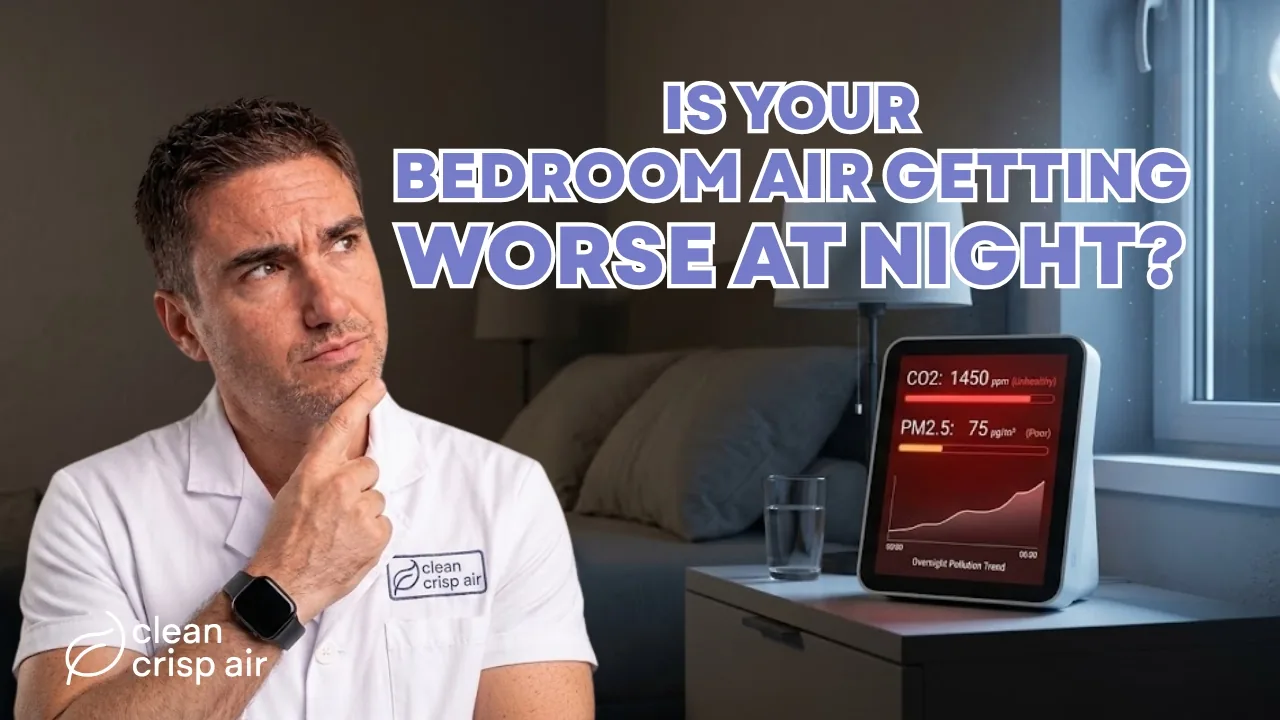
Bedroom air quality at night can get worse because a closed, occupied room receives less fresh air while people keep exhaling carbon dioxide, moisture keeps building, and particles or gases may remain in the room. An air purifier can reduce airborne particles, but it cannot remove CO2 or control humidity. The useful question is not whether one number rises. It is which number changes, when it changes, and what fixes that specific problem.
This guide turns our seven-night bedroom test into a method you can repeat at home. You will compare PM2.5, carbon dioxide, relative humidity, and temperature under different ventilation and filtration setups. You do not need laboratory equipment, but you do need consistency and a willingness to treat one odd night as an odd night rather than a scientific breakthrough.
Watch the full Clean Crisp Air seven-night bedroom air quality video for the visual version, then use the steps below to test your own room.
Why bedroom air changes while you sleep
Your bedroom may look exactly the same at 7 a.m. as it did at 10 p.m., but the air has spent hours inside a smaller, often closed space. The door may be shut for privacy. The windows may be closed for security, noise, weather, or energy use. Heating or cooling may cycle on and off. Meanwhile, one or two people keep breathing, bedding releases particles when it moves, and indoor sources continue emitting gases.
The US Environmental Protection Agency explains that inadequate ventilation can allow indoor pollutants to accumulate because too little outdoor air enters to dilute them or carry them away. Temperature and humidity can also affect the concentration of some pollutants.[1] That does not mean every bedroom becomes dangerous overnight. It means a closed room can behave differently from the rest of the home, so measuring the bedroom itself matters.
CO2 rises when fresh-air exchange is low
Every sleeper exhales carbon dioxide. In a small or tightly sealed bedroom, CO2 can climb when fresh air does not replace the air you breathe. A portable particle monitor may show beautiful PM2.5 readings while CO2 keeps rising. Both readings can be correct because they describe different problems.
An ASHRAE report on controlled bedroom ventilation research described much higher overnight CO2 under low-ventilation conditions than when an outdoor-air supply fan was used. In that study, average CO2 was 2,395 ppm with low ventilation and 835 ppm with increased ventilation.[2] Those numbers came from a specific study, not your bedroom. Use them as a reason to measure, not as a promise that your readings will match.
PM2.5 follows particles, airflow, and outdoor conditions
PM2.5 means fine particles with an aerodynamic diameter of 2.5 micrometers or smaller. Sources can include outdoor pollution, smoke, cooking, candles, aerosols, dust, and particles stirred up by movement. A properly sized purifier with an effective particle filter can lower PM2.5, but the outcome depends on room size, fan speed, placement, filter condition, and how quickly new particles enter.
Outdoor air is not automatically cleaner at night. A Nature Geoscience editorial notes that stable nighttime atmospheric conditions can suppress vertical mixing and that global PM2.5 levels often peak in the early evening, although local conditions vary widely.[4] Check your local outdoor AQI before opening a window. Ventilating with smoky or heavily polluted outdoor air can trade a CO2 problem for a particle problem.
Humidity and temperature need their own fix
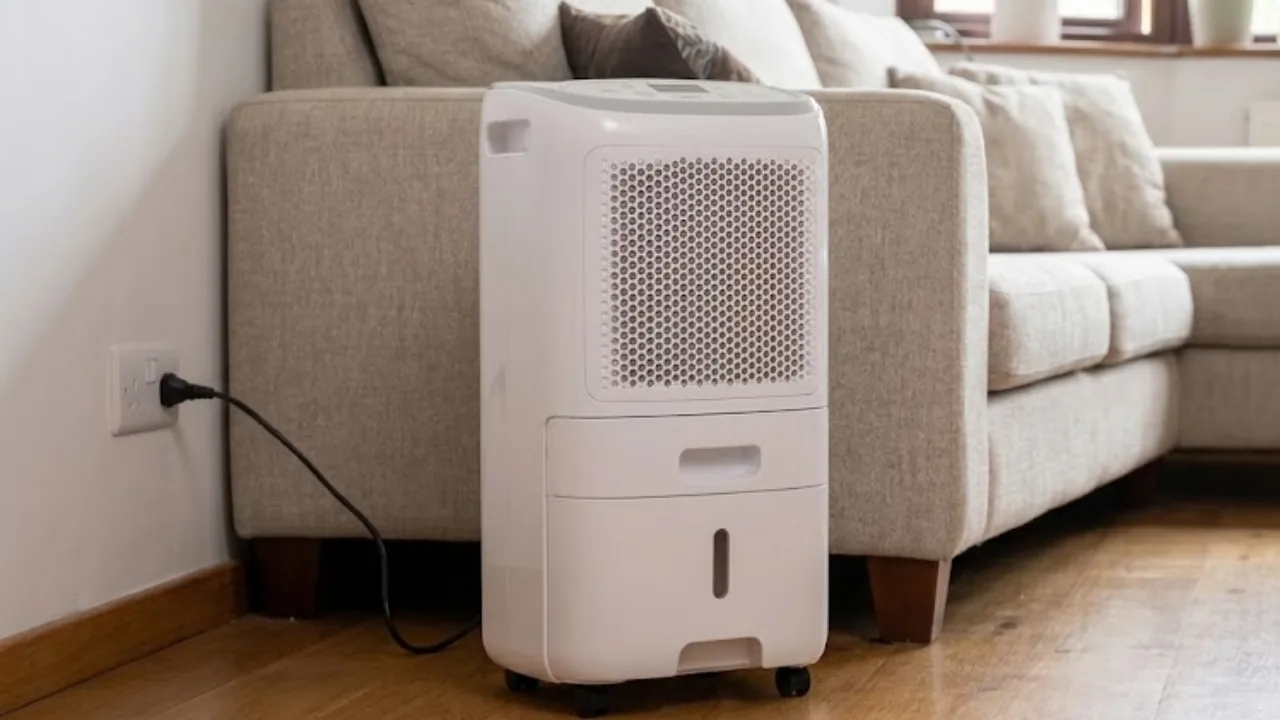
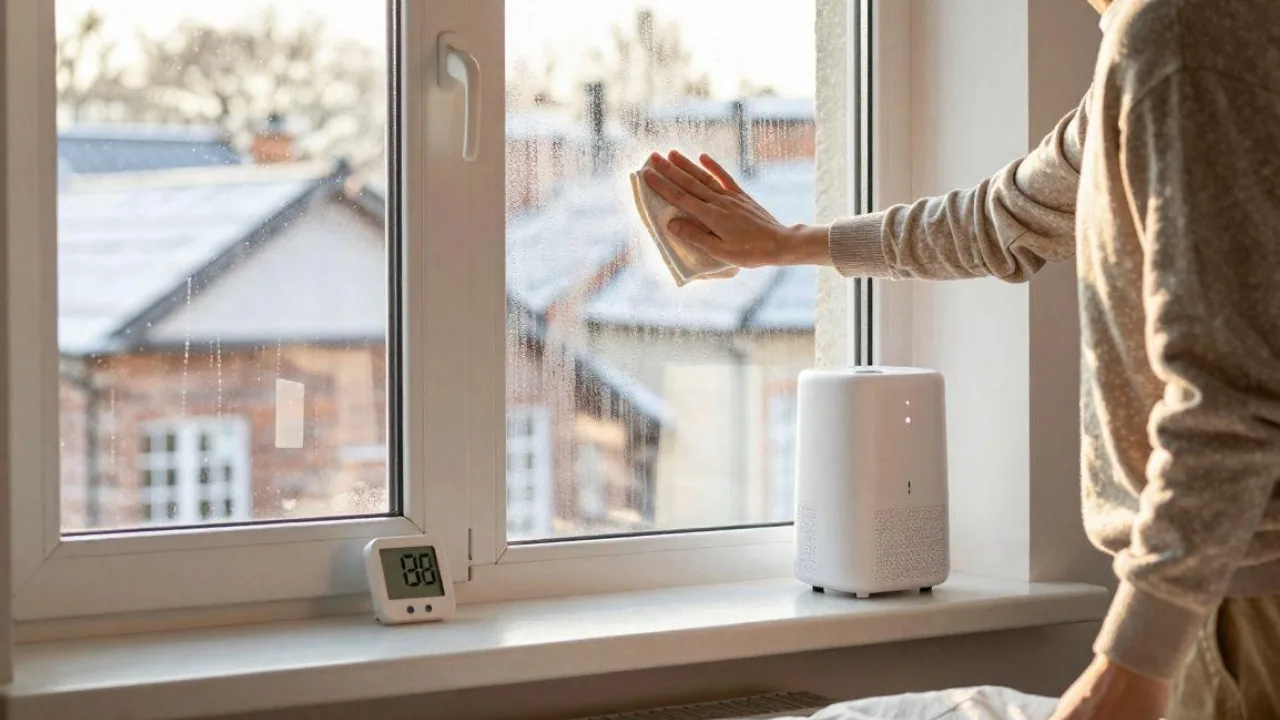
People add moisture to a room through breathing and perspiration. Weather, construction, HVAC operation, damp materials, and attached bathrooms also affect relative humidity. A particle purifier does not remove meaningful moisture. If humidity stays high, inspect moisture sources and consider ventilation or dehumidification. If the room is too dry, more filtration will not help.
If you are deciding between devices, read our guide to air purifiers versus humidifiers. If you need both particle filtration and moisture removal, see whether you can run a dehumidifier and air purifier in the same room.
VOCs and odors do not behave like particles
Volatile organic compounds can come from furnishings, flooring, cleaning products, fragrances, personal-care products, paint, and other materials. Some purifiers contain activated carbon for certain gases and odors, but a thin carbon sheet has limited capacity. Source control and ventilation usually matter more than expecting one filter to handle every gas in the room.
How to run a seven-night bedroom air quality test
The goal is not to crown a gadget. It is to learn how your room responds when you change one condition at a time. Use the same bedroom, monitor location, bedtime range, and number of occupants when possible.
What to record before each night
- Bedroom dimensions or estimated room volume
- Number of occupants and whether pets sleep in the room
- Outdoor AQI and weather conditions
- Door and window position
- Purifier model, filter condition, placement, and fan setting
- Heating, cooling, humidifier, or dehumidifier operation
- Bedtime, wake time, and unusual events such as cooking, candles, cleaning sprays, or smoke
Place the monitor away from the sleeper's face, an open window, a supply vent, and the purifier outlet. A monitor sitting in one concentrated airflow stream may describe that stream rather than the room. Keep it at roughly breathing-zone height and use the same position every night.
A practical seven-night sequence
- Night 1: closed-room baseline. Keep the door and window closed and the purifier off. This gives you a reference, not a verdict.
- Night 2: repeat the baseline. A second baseline shows whether Night 1 was typical or distorted by an unusual event.
- Night 3: leave the door ajar. Keep the window closed and purifier off. Watch whether CO2 changes as air mixes with the rest of the home.
- Night 4: run the purifier on a realistic sleep setting. Keep the door and window in the baseline position. Check whether PM2.5 changes while CO2 follows its own pattern.
- Night 5: crack the window only if outdoor AQI and conditions are acceptable. Note the opening size and check both CO2 and PM2.5.
- Night 6: combine the most promising ventilation setup with filtration. This tests whether you can manage particles and accumulated CO2 at the same time.
- Night 7: repeat the best setup. Repetition is less exciting than a dramatic graph, but it is far more useful.
Do not compare a quiet, cool Tuesday with a smoky weekend after cooking and pretend the intervention caused every difference. Note what changed. Consumer monitors also have limitations, so focus on repeatable patterns rather than false precision.
How to read the results without fooling yourself
Look at each measurement separately before judging the room as simply good or bad. The most useful result is often a split result.
PM2.5 falls, but CO2 keeps rising
The purifier is probably doing its particle job while fresh-air exchange remains low. Do not respond by buying a second purifier to solve CO2. Test safer ventilation options, such as leaving the door ajar or using a mechanical fresh-air system, while checking outdoor air quality.
CO2 falls, but PM2.5 rises
Opening the door or window improved air exchange, but particles entered from another room or outdoors. Check outdoor AQI and indoor sources. A combination of cleaner ventilation and filtration may work better than choosing one and ignoring the other.
Humidity remains high in every setup
The room may have a moisture source that brief ventilation does not overcome. Look for damp materials, bathroom moisture, condensation, leaks, poor exhaust, or an undersized dehumidifier. Our dehumidifier and condensation guide explains when moisture removal helps and when the building problem needs a different repair.
Readings spike at one specific time
Match the spike to activity. Evening cooking, candles, cleaning products, an HVAC cycle, a nearby road, or a window opening may explain more than the average for the whole night. A time-based graph is more revealing than comparing only bedtime and morning numbers.
Use the right fix for the pollutant
Indoor-air fixes are not interchangeable. Start with the source whenever you can, then use ventilation, filtration, or moisture control for the part that remains.
- For elevated CO2: improve fresh-air exchange when outdoor conditions, safety, noise, and weather allow. A standard portable air purifier does not remove CO2.
- For PM2.5: remove particle sources and use appropriately sized filtration. Keep the intake and outlet clear. Our guides explain the best location for an air purifier and whether to place an air purifier on a table or the floor.
- For high humidity: reduce moisture at the source, improve exhaust or ventilation where appropriate, and use a correctly sized dehumidifier if needed.
- For low humidity: avoid automatically adding moisture until you have measured the room and checked for condensation risk.
- For gases and odors: remove or reduce the source first. Ventilate when conditions allow. Treat carbon filtration as a limited tool, not magic.
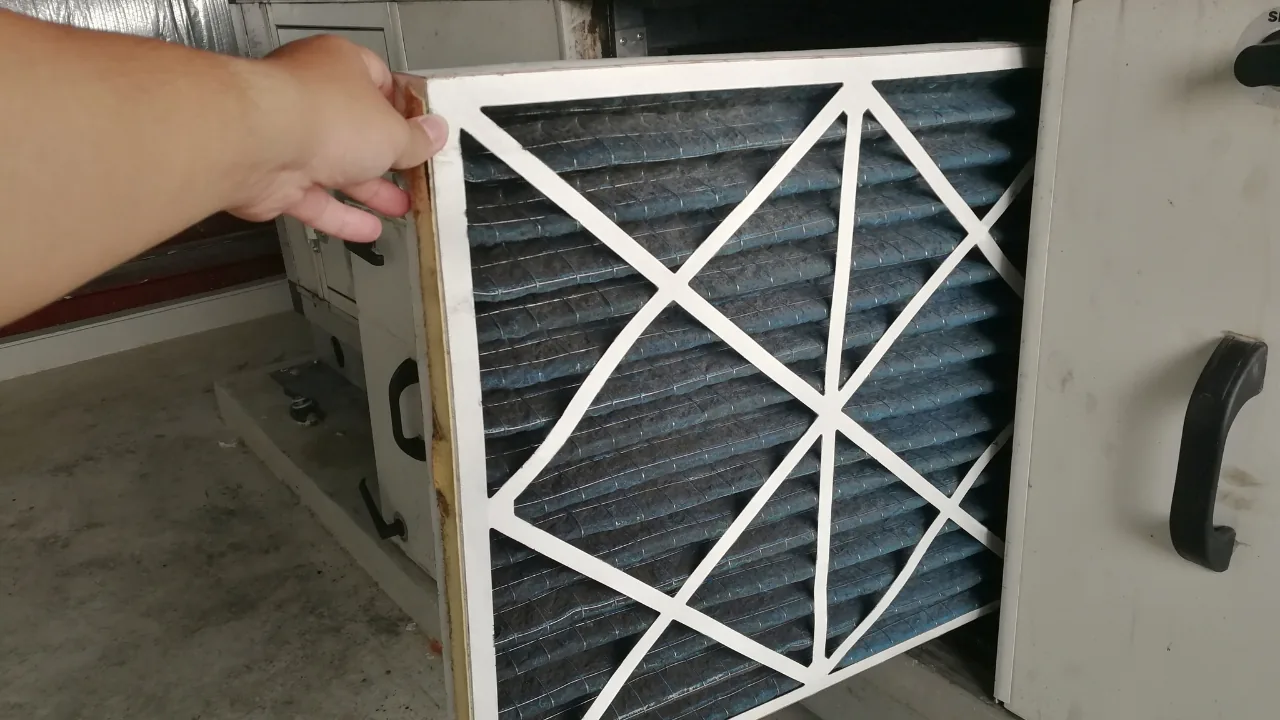
If your central HVAC filter is part of the plan, do not assume the highest rating is always safest for the system. Read our guide to MERV ratings and airflow compatibility before increasing filter resistance.
Should you run an air purifier at night?
You can run a properly maintained purifier overnight if the manufacturer allows continuous operation and the unit is positioned safely with clear airflow. Use a fan setting you can tolerate, but remember that an ultra-low sleep setting may move too little air for the room. Check the unit's smoke-free CADR or room-size guidance rather than relying on marketing coverage alone.
An overnight purifier can help with particles. It cannot replace fresh-air ventilation for accumulated CO2, and it cannot replace a humidifier or dehumidifier. If the purifier lowers PM2.5 while other readings remain poor, believe the split result.
Should you sleep with the window open or closed?
There is no universal answer. An open window may improve ventilation and lower bedroom CO2, but it can also bring in outdoor particles, humidity, noise, allergens, or unsafe temperatures. Check local AQI and weather, consider security and noise, and compare your own readings. If outdoor air is poor, keep the window closed and look for cleaner mechanical ventilation or door-position options.
Can poor air quality affect sleep?
Research has reported associations between air-pollution exposure and adverse sleep outcomes, but the evidence covers different pollutants, populations, and study designs. A systematic review of 22 studies found associations while also noting that the varied methods and generally limited certainty prevent simple cause-and-effect conclusions.[3] Avoid turning one consumer-monitor reading into a diagnosis.
Morning congestion, headaches, poor sleep, or irritation can have many causes. If symptoms are persistent, severe, or linked to suspected mold, smoke, combustion, or chemical exposure, consult a qualified professional. If a carbon monoxide alarm sounds or you suspect carbon monoxide, leave the area and follow emergency guidance. CO2 from breathing and carbon monoxide from combustion are different gases with very different risks.
A five-minute checklist for tonight
- Check outdoor AQI and weather.
- Avoid candles, smoking, aerosols, and strong fragrances before bed.
- Put the monitor in a representative location, not beside the purifier or your face.
- Give the purifier clear intake and outlet space.
- Record PM2.5, CO2, humidity, and temperature at bedtime and after waking.
- Change only one major condition on the next night.
Seven nights will not turn your bedroom into a laboratory. They can still reveal whether you need fewer particle sources, better filtration, more fresh air, moisture control, or a combination. Measure first, match the fix to the reading, and stop asking one machine to solve four different problems.
Watch the companion video, Why Is Your Bedroom Air Quality Worse at Night? A 7-Night Test, for the visual walkthrough.
Comments