
Why Does Cooking Spike PM2.5? Range Hood vs Air Purifier
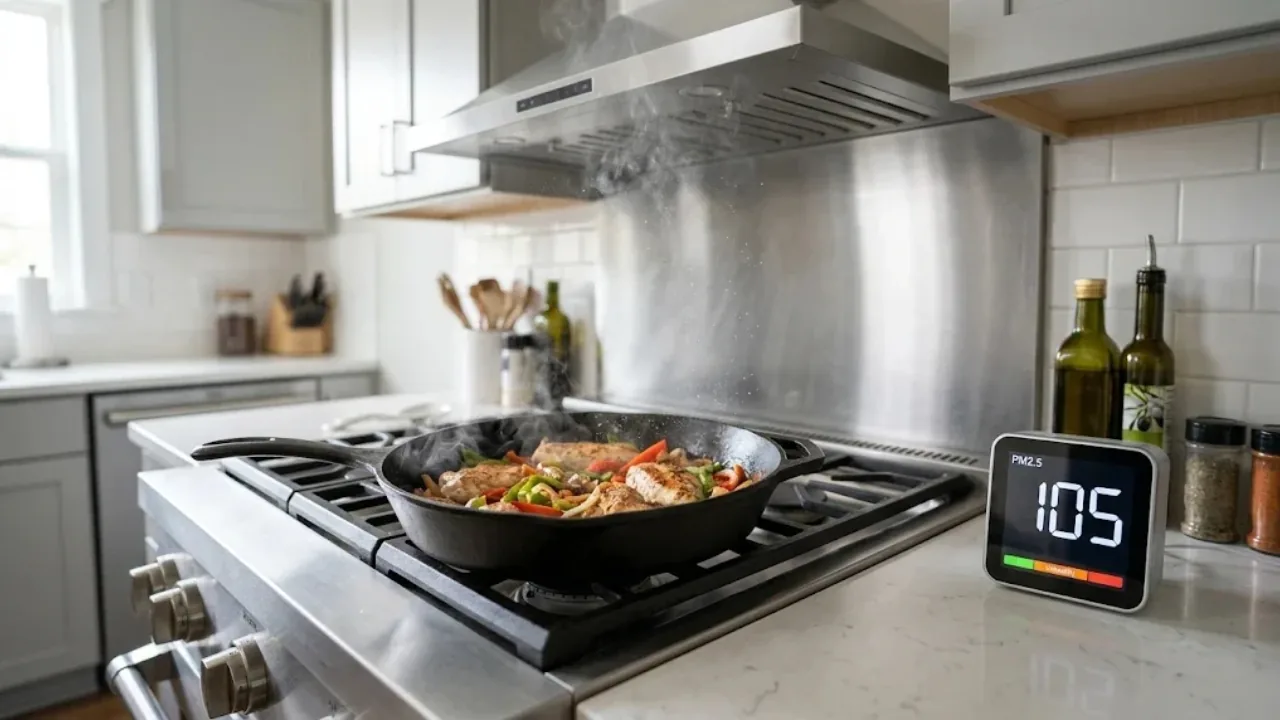
Cooking can spike indoor PM2.5 even when there is no dramatic cloud of smoke. Frying, sautéing, grilling, broiling, baking and accidentally overheating food or oil can release fine particles into kitchen air. The size of the spike depends on the food, cooking method, heat, fat, ventilation, room volume and what the monitor can actually detect.
The practical response is not “buy the biggest gadget.” It is to control pollution as close to the source as possible, then clean up particles that escape. That usually puts an effective range hood vented outdoors first and a correctly sized particle air purifier second.
Image note: The featured image is illustrative. The PM2.5 value shown is not a reported Clean Crisp Air test result.
Why does cooking increase PM2.5?
PM2.5 means airborne particulate matter with an aerodynamic diameter of 2.5 micrometers or smaller. These particles can remain suspended, spread beyond the kitchen and be inhaled. A consumer PM2.5 monitor estimates particle mass from the light scattered by particles passing through its sensor; it does not identify the material or prove where every particle came from.
The US Environmental Protection Agency identifies cooking as a common indoor PM source. The EPA notes that the food, cooking method and cooking fat all affect particle production, while burned food can generate large quantities quickly. Ordinary cooking can still produce particles before anything looks obviously smoky.
The food and pan can produce particles on any stove
Hot oil, fat, food residue and ingredients can generate aerosols and fine particles. That means an induction or electric cooktop does not make the cooking process particle-free. Changing the fuel can reduce some burner-related pollutants, but it does not eliminate emissions from the pan.
Gas adds a separate combustion problem
Gas burners can add combustion pollutants, including nitrogen dioxide, carbon monoxide and ultrafine particles. A PM2.5 monitor does not measure every one of those pollutants. It is not a carbon monoxide alarm, and a lower PM2.5 reading does not prove that combustion gases are controlled.
Use properly installed certified smoke and carbon monoxide alarms, maintain fuel-burning equipment and never use a cooking appliance to heat a home. If a CO alarm sounds, move outside and contact emergency services rather than watching a consumer air-quality dashboard.
Watch: why PM2.5 can spike on any stove
This companion Clean Crisp Air video explains why cooking pollution is not limited to one stove type and why ventilation matters:
Watch “Cooking Pollution: Why PM2.5 Spikes on Any Stove” directly on YouTube.
Range hood vs air purifier: which should come first?
Use an effective outdoor-vented range hood first, then use an air purifier as supplemental particle control. The two devices work at different stages of the problem.
- Outdoor-vented range hood: tries to capture heat, moisture, particles and some gases before they spread through the room, then exhausts them outdoors.
- Particle air purifier: recirculates room air and removes a portion of airborne particles that reach its filter.
- Recirculating hood: passes air through grease and sometimes carbon filters before returning it to the kitchen. Its performance depends on the filters and design, but it does not equal outdoor exhaust and does not remove cooking moisture from the home.
Calling the contest “range hood versus air purifier” is useful for testing, but the best setup is often not either-or. Source capture and room filtration can work together. What matters is matching each control to the pollutant it can actually address.
Why source capture usually wins the first move
A vented hood can intercept emissions while they are concentrated in the thermal plume above the pan. Once pollutants escape into the room, they mix into a much larger air volume. The purifier then has to wait for polluted air to reach its intake.
Lawrence Berkeley National Laboratory research shows why hood geometry, airflow and burner position matter. In a controlled study of four exhaust hoods, particle capture was generally much better for cooking on a back burner than for high-heat stir-frying on a front burner. The result is not a promise that every back burner or high fan setting will achieve the same percentage; it shows that capture depends on the relationship among the plume, hood and airflow.
What an air purifier can do after particles escape
A purifier with an effective particle filter and enough clean-air delivery can lower airborne PM2.5 after it enters the room. A 2021 apartment experiment published in Building and Environment found that cooking-related PM2.5 spread beyond the kitchen and that portable air cleaners and window ventilation reduced concentrations and decay time under the tested scenarios. In that experiment, placing the purifier closer to the kitchen source performed better than placing it farther away.
That does not mean the purifier should sit beside a hot stove or block a walkway. Follow its clearance, temperature and grease-exposure instructions. Place it where it can move room air safely without aiming its clean-air jet directly at the monitor.
What an air purifier cannot replace
A standard particle purifier does not exhaust heat or moisture, lower accumulated carbon dioxide, or reliably remove every gas produced during cooking. Activated carbon may reduce selected gases or odors when the media and contact time are adequate, but a thin carbon sheet is not universal protection.
For a broader breakdown of filter strengths and limits, see our evidence-based guide to what air purifiers remove. If central filtration is part of the plan, our MERV ratings guide explains why filter efficiency, fit and HVAC airflow must be considered together.
How to get more from a range hood
Confirm that it actually vents outdoors
Do not assume a fan over the range is ducted outside. A recirculating model may send air back through vents above the microwave or cabinet. Check the manual, exterior termination and installation documentation. If the system is supposed to exhaust outdoors but airflow seems weak, a qualified contractor can inspect the duct route, damper, termination and fan.
Turn it on before cooking and use it throughout
Starting the hood after the kitchen already looks hazy misses the point of source capture. Turn it on before the pan gets hot, run it during the full cooking event and leave it on after cooking according to the manufacturer’s guidance.
The EPA’s current cooking guidance recommends using an outdoor-vented hood whenever cooking, cooking on back burners where practical and leaving the hood on for 10–20 minutes afterward. That fixed time is a practical baseline, not proof that every kitchen clears at the same rate.
Use back burners when practical
Many under-cabinet hoods do not fully cover the front burners. A hot plume from the front can roll past the hood edge before the fan captures it. Using a back burner can put the plume deeper beneath the capture area—provided the pan size, handles and cooking method remain safe.
Use the highest practical setting
More airflow often improves capture, but noise, hood geometry, duct resistance and makeup air all matter. A loud hood that nobody uses is a shiny piece of kitchen sculpture. Keep grease filters clean and follow the manufacturer’s maintenance schedule.
High-flow exhaust can depressurize a tight home and contribute to backdrafting of naturally drafted combustion appliances. If the hood is powerful or the home has fireplaces, water heaters or furnaces that draw room air, ask a qualified building or HVAC professional about makeup air and combustion safety.
A transparent range hood vs air purifier test
A useful home comparison repeats one normal cooking process under documented conditions. It does not deliberately burn food, overheat oil or manufacture a dramatic graph for content. Safety beats spectacle. Every time.
What to record before each trial
- room length, width and ceiling height;
- cooking method, food, pan and approximate heat setting;
- burner position and cooking duration;
- hood type, whether it vents outdoors and its fan setting;
- purifier make, model, filter type, fan setting and published CADR if available;
- PM2.5 monitor model, warm-up time and position;
- doors, windows, HVAC operation, occupancy and nearby activities;
- outdoor PM2.5 or AQI when available;
- baseline, peak and readings at fixed intervals after cooking stops.
Use our home air-quality testing protocol to keep monitor placement and contextual notes consistent.
Three conditions to compare
- Normal cooking with no active hood or purifier: Use only if it is safe and consistent with appliance instructions. This establishes the room’s natural PM2.5 rise and decay under that specific setup.
- The same cooking process with the outdoor-vented hood running: Start it before heating begins and keep the burner, pan, food, monitor and room setup as consistent as practical.
- The same process with supplemental particle filtration: Define whether the purifier runs alone or together with the hood. The combined condition usually reflects the strongest practical control, while purifier-only helps isolate what filtration can do after particles escape.
Repeat trials on comparable days when possible. One run can be distorted by a different oil temperature, HVAC cycle, open door, outdoor pollution change or monitor position.
How to interpret the graph
Compare more than the highest number. Useful measures include:
- Baseline: the stable PM2.5 level before cooking;
- Peak above baseline: the highest increase associated with the event;
- Time to peak: how quickly the monitor responded;
- Decay time: how long readings took to return near the pre-cooking baseline;
- Integrated exposure: the area under the concentration-versus-time curve, which accounts for both magnitude and duration.
A lower peak during the hood trial supports better capture under those conditions. A faster decline during the purifier trial supports greater particle removal from room air. Neither result proves removal of nitrogen dioxide, carbon monoxide, every ultrafine particle or every volatile compound.
No raw Clean Crisp Air PM2.5 dataset was supplied with this draft, so this article does not invent a baseline, peak, reduction percentage or winner. Add numerical conclusions only after the monitor export, setup notes and trial conditions can be checked.
Consumer PM2.5 monitor limitations
Low-cost optical monitors are useful for detecting patterns, but they are not reference-grade laboratory instruments. Particle composition, size, humidity, airflow and the device’s conversion algorithm can change the reported mass estimate. Some cooking emissions may fall outside what a specific sensor measures well.
The EPA’s guidance on low-cost indoor air monitors stresses that these devices measure only the pollutants or conditions they were designed to detect. Treat the graph as evidence about a measured signal—not a complete certificate of safe air.
For a fair comparison, keep the monitor in representative breathing-zone air, away from the hood exhaust, purifier outlet, open window and direct stove plume. A sensor beside the purifier outlet can make whole-room cleaning look faster than it is.
Fastest practical ways to reduce cooking PM2.5
- Use an outdoor-vented range hood from before cooking starts until after the event ends.
- Cook on back burners when practical and safe.
- Use a lower temperature when the recipe allows, and avoid intentionally charring or burning food.
- Keep pans, burners, the oven and hood grease filters clean.
- Use a correctly sized particle air purifier as a supplement, especially when source capture is incomplete.
- Open windows or doors only when outdoor air quality, weather and security make it appropriate; cross-drafts can sometimes disrupt hood capture.
- Upgrade central filtration to MERV 13 or the highest efficiency the system can accommodate, following equipment guidance.
Frequently asked questions
Can cooking raise PM2.5 without visible smoke?
Yes. Fine and ultrafine particles can be present before a plume becomes obvious to the eye. Use ventilation from the start rather than waiting for visible smoke.
Is an air purifier better than a range hood for cooking pollution?
Usually not as the first control. An effective outdoor-vented hood can capture pollutants near the source and exhaust them. A purifier is valuable for airborne particles that escape, but it does not replace outdoor exhaust for gases, heat and moisture.
Does a recirculating range hood remove PM2.5?
Some recirculating hoods can reduce certain particles when their filters, airflow and maintenance are adequate, but performance varies. They return air to the room and do not provide the same pollutant removal as a hood that exhausts outdoors.
Should the air purifier run while cooking?
It can run during and after cooking if the manufacturer permits that placement and use. Keep it away from heat and grease, do not block airflow and use a setting that provides meaningful clean-air delivery.
Does a PM2.5 monitor detect nitrogen dioxide or carbon monoxide?
No. A PM2.5 sensor measures a particle-related signal. Use pollutant-specific instruments where appropriate and certified CO alarms for emergency warning.
The bottom line
Cooking PM2.5 is a source-control problem first and a room-cleaning problem second. Use a range hood that actually exhausts outdoors, start it early, favor back burners when practical and keep it running after cooking. Then use correctly sized particle filtration to catch some of what escapes.
Measure the setup honestly. Keep the conditions consistent, disclose what changed and stay inside the limits of the sensor. A graph without context is content confetti; a repeatable protocol can improve the air you actually breathe.
Sources and further reading
- US EPA: Sources of Indoor Particulate Matter
- US EPA: Strategies for Improving Indoor Air Quality While Cooking
- Lunden, Delp and Singer: Capture efficiency of cooking-related fine and ultrafine particles by residential exhaust hoods
- Xiang et al.: Residential cooking-related PM2.5 under intervention scenarios
- US EPA: Guide to Air Cleaners in the Home
- US EPA: Low-Cost Air Pollution Monitors and Indoor Air Quality
Comments