
Harbor Breeze ceiling fan troubleshooting: remote, light and motor
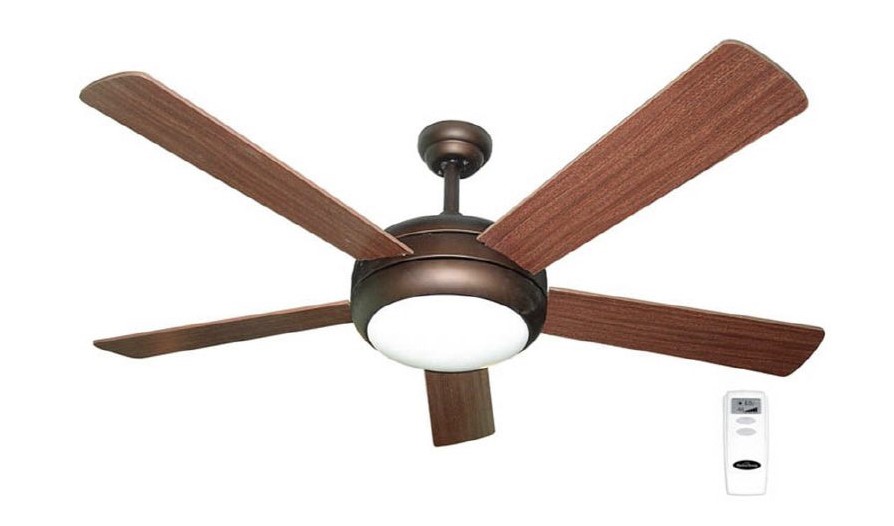
Quick Answer: Start with the breaker: switch the fan off for 30 seconds and back on. Then fresh batteries. Then re-pair the remote, which on Harbor Breeze means either a learn button or matching dip switches depending on the model's age. A light kit that dims or cuts out on its own is usually the wattage limiter, not a fault. A fan that hums but will not spin is the capacitor, and that is a replacement part rather than an adjustment.
Harbor Breeze is Lowe's house brand, so there is no separate manufacturer support line. Warranty and parts go through Lowe's, and the model number on the plate inside the canopy is what you need before calling. If you want the background on who actually builds them, we cover that in who makes Harbor Breeze ceiling fans.
Work in this order
| Symptom | Most likely cause | First thing to try |
|---|---|---|
| No response to the remote | Batteries or lost pairing | Breaker power-cycle, then batteries, then re-pair |
| Fan runs, light does not | Bulbs, or the wattage limiter | Check the bulb type and total wattage |
| Light dims or cuts out after a while | Wattage limiter doing its job | Fit lower-wattage bulbs |
| Fan hums but does not spin | Capacitor | Stop using it. Parts job |
| Will not turn off at the wall switch | Failed switch, or a stuck receiver | Trip the breaker to tell them apart |
| Turns on or off by itself | Dip switch clash with a nearby device | Change the code on remote and receiver |
| Will not reverse | Reverse switch, or pairing | Check the slider is fully over, not mid-travel |
Before anything else
Turn the fan off at the breaker, wait 30 seconds, and switch it back on. A receiver that has locked up after a power blip recovers from this and nothing else, and it costs you a minute.
Then fit new batteries rather than testing the old ones, and press the battery door fully closed. A loose door is a surprisingly common cause of a remote that works intermittently.
The remote does not work
If the fan responds to the wall switch but not the handset, the fan and its wiring are fine and you have a remote or pairing problem.
Harbor Breeze uses two different pairing systems, which is why instructions you find online contradict each other:
- Learn button. Newer handsets have a small recessed button in the battery compartment. Cut power at the breaker for 30 seconds, restore it, and within the first 30 seconds press and hold the learn button until the fan responds.
- Dip switches. Older fans pair by a bank of tiny sliding switches that must read identically in the handset and in the receiver above the light kit. Both sets have to match exactly.
Look in your remote's battery compartment first. Whichever you find there tells you which system your fan uses.
Matching the dip switches
- Turn the power off at the breaker, not just the wall switch, and leave it off for the whole job.
- Open the remote's battery compartment, remove the battery, and note the switch pattern.
- On a stable ladder, remove the light kit shade to reach the receiver above it.
- Set the receiver's switches to the same pattern. If the fan has been turning itself on, choose a different pattern and set both to it.
- Reassemble, restore power, and test.
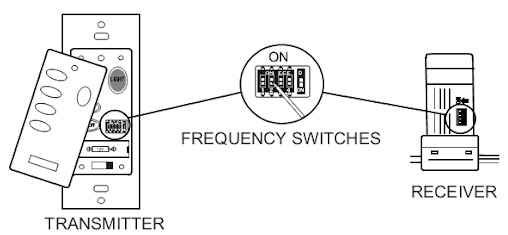
A fan that operates on its own is nearly always a code clash with a neighbour's fan or a garage door opener on the same pattern. Changing the code fixes it.
The light will not come on, or cuts out by itself
Bulbs first, and check you are within the fixture's rated wattage. Then consider the part most people do not know is there.
Many Harbor Breeze light kits contain a wattage limiter, a small module that cuts the light when total bulb wattage exceeds the fixture's rating. It is a safety device, not a fault. If the light works briefly then dies, or never comes on after someone fitted brighter bulbs, the limiter is the first suspect. Fitting LED bulbs, which draw far less power for the same brightness, is usually the whole fix.
If the light never worked from installation, the cause is more likely the switch leg than the fixture, and our guide to a ceiling fan light that will not work covers those cases. Wire colors are in our ceiling fan wire color guide.
The fan hums but does not spin
That hum is the motor receiving power and failing to start, and the usual cause is the starting capacitor.
This page used to tell readers to open the motor housing and replace it themselves. That advice has been removed. A capacitor stores charge after the power is off, it sits on a circuit that has been live, and on most Harbor Breeze models it is not sold as a user-serviceable part. Given what a new fan costs against an electrician's call-out plus a part that may not be available, replacing the fan is often the rational choice.
Before assuming the capacitor, rule out the free causes: with the power off, spin a blade by hand. If it binds or grinds, the problem is bearings or an obstruction, not electronics.
It will not turn off at the wall switch
Trip the breaker. If the fan stops, the motor and its wiring are fine, and you have either a failed wall switch or a receiver stuck on. Our guide to troubleshooting a ceiling fan wall switch separates the two.
Replacing a wall switch is within reach for a competent DIYer in most of the US, with the breaker off and the circuit proven dead first. If you are not certain which breaker feeds it, that uncertainty is the answer: get an electrician.
It will not reverse
- Check the slider is fully over. A reverse switch left mid-travel leaves the fan running in neither mode or not at all.
- On remote-controlled reverse, re-pair first, because reverse is often the first function to drop out of a partial pairing.
- Reverse switches wear. On an older fan the switch itself is the likely culprit.
While you are there, make sure you know which direction you actually want. Our guide on which way a ceiling fan should turn covers summer and winter.
When to stop
Turn it off at the breaker and get an electrician for a burning smell, scorch marks, a fan that trips the breaker, a hot motor housing, or any exposed or damaged conductor. OSHA's own rule for de-energised work, 1910.334, exists because the failure mode here is not a broken fan.
Worth knowing before you buy a replacement: fan efficiency is measured and published, and ENERGY STAR's ceiling fan listings let you compare airflow per watt rather than guessing from the box.
Frequently asked questions
How do I reset a Harbor Breeze ceiling fan?
Switch it off at the circuit breaker for 30 seconds and back on. That clears a locked-up receiver and is the first step for almost every symptom on this page.
Where is the learn button on a Harbor Breeze remote?
Inside the battery compartment, usually recessed so it cannot be pressed by accident. Older models have dip switches there instead and no learn button at all.
Why does my Harbor Breeze light turn off by itself?
Most likely the wattage limiter cutting the light because total bulb wattage exceeds the fixture rating. Fit LED bulbs of a lower wattage and it usually stops.
Why does my fan hum but not spin?
The motor is getting power and cannot start, which points at the starting capacitor once you have ruled out an obstruction by spinning a blade with the power off.
Can I use any universal remote with a Harbor Breeze fan?
Only one that matches the receiver in your fan, and whether that is a learn-button or dip-switch system. Check the model number before buying.
Why does my ceiling fan turn on by itself?
Another RF device nearby is on the same dip switch code. Change the pattern on both the remote and the receiver.
Is it worth repairing a Harbor Breeze fan or replacing it?
Remote, batteries, bulbs, pairing and loose screws are all worth fixing. Once you are into a capacitor, a motor or a receiver on an older fan, compare the part plus labour against a new fan honestly, because it is often close.
Comments