
How to use a Fanimation remote control
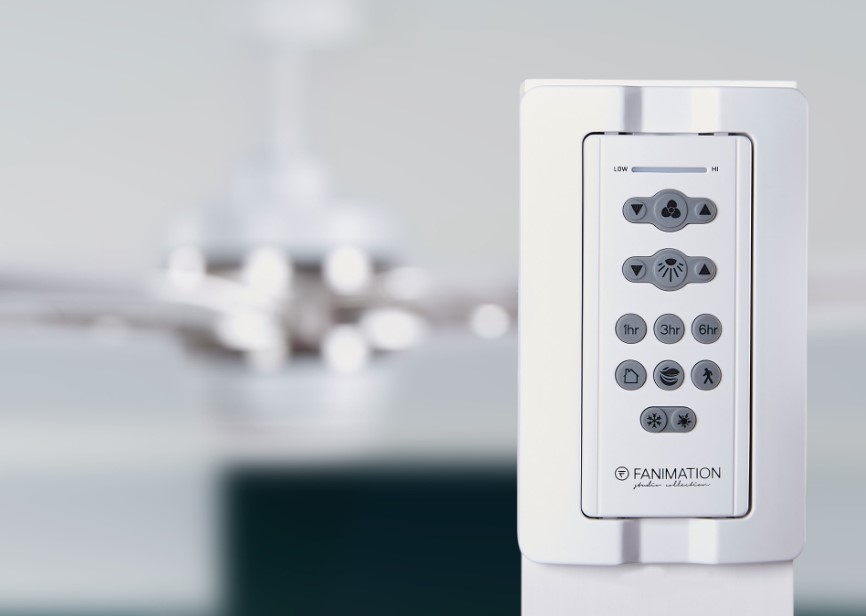
Quick Answer: On most Fanimation handsets the up and down arrows set fan speed, the centre button in that row stops the fan, the bulb button toggles the light and dims it when held, and the numbered buttons are sleep timers. The odd icons are a walking figure for walk-away light delay, a house for home shield, and separate summer and winter buttons for direction. The learn button, where fitted, is recessed inside the battery compartment.
Fanimation ships several different handsets and they do not share a layout, so the fastest route is to identify your model and read the icons rather than guess. Current owner's manuals sit under the Support Documents tab on each fan's own product page at Fanimation's support site. If your remote is not responding at all, that is a different problem and our Fanimation troubleshooting guide covers it.
What each button does
| Icon or label | What it does | Notes |
|---|---|---|
| Bulb | Light on and off. Hold to dim or brighten | Press and release to toggle, press and hold to dim |
| Up and down arrows, fan row | Start the fan and step the speed up or down | Pressing either from off will start the fan |
| Centre button, fan row | Stops the fan | Leaves the light as it was |
| Up and down arrows, light row | Brightness up and down | Separate from the fan arrows |
| One, two or three dots | Low, medium and high speed directly | On handsets with fixed-speed buttons rather than arrows |
| 1hr, 3hr, 6hr | Sleep timer. Fan and light switch off after that long | Press again to cancel on most models |
| Walking figure | Walk-away light delay. Light goes off after about a minute | Press once as you leave the room |
| House | Home shield. Fan off, light cycles on and off at random | An occupancy simulation for when you are away |
| Breeze or wave | Modulates fan speed to imitate a natural breeze | Sometimes labelled neutral breeze |
| Summer and winter | Reverses the blade direction | Some handsets have one reverse button instead of two |
| LEARN, recessed | Pairs the handset to the fan's receiver | Inside the battery compartment, needs a pointed object |
Layouts vary. The FP6728 series uses fixed-speed dot buttons, while the TW206 uses arrow rows and carries the full set of extras. The JY1004 and CR500 handsets are close enough to the TW206 that the same descriptions apply.
Using the learn button
On handsets that have one, such as the CRL4WH, the learn button pairs the remote to the receiver and is the fix after a power cut wipes the pairing.

- Restore power to the fan at the breaker.
- Within 60 seconds, open the battery cover and press and hold LEARN for about three seconds using a pointed object.
- The fan switches off and then runs at medium speed. That is the pairing confirmed.
The 60-second window is the part that catches people out. If you miss it, cut the power again and start over.
Summer and winter
The two direction buttons do the same job as a physical reverse switch. Summer runs the blades anticlockwise viewed from below, pushing air down as a cooling draught. Winter runs them clockwise and slowly, pulling air up so warm air at the ceiling is displaced down the walls without a draught you can feel.
If your handset only has one reverse button, such as the TR29, it toggles between the two. Our guide on which way a ceiling fan should turn explains when each is worth using.
When the fan ignores the remote
- Fit new batteries and close the compartment fully.
- Power-cycle at the breaker for 30 seconds. This clears a locked-up receiver and reopens the pairing window.
- Re-pair, using the learn button if you have one, or by matching the dip switches in the handset to those in the canopy receiver if you do not.
- Try the wall switch. If the fan runs from the wall, the fault is definitely the handset or the pairing.
One thing not to bother with, because the old version of this page suggested it: there is no need to clear a path between the remote and the fan. These are radio handsets, not infrared ones. They work through furniture, from another angle, and often from the next room. If yours only works when you point it at the fan, that is a weak battery, not a line-of-sight problem.
Frequently asked questions
What is the button with a person walking on a Fanimation remote?
Walk-away light delay. Press it once and the light switches off after roughly a minute, so you can leave the room in light.
What does the house button do?
Home shield. It turns the fan off and cycles the light on and off at random intervals so the house looks occupied while you are away.
Where is the learn button on a Fanimation remote?
Recessed inside the battery compartment, so you need a pen tip or paperclip. Not every handset has one; older models pair by dip switches instead.
How do I set the sleep timer?
Press the 1hr, 3hr or 6hr button. The fan and light switch off after that period. On most handsets pressing the same button again cancels it.
Do I need to point the remote at the fan?
No. Fanimation handsets are radio, not infrared, so they do not need line of sight. If pointing seems to help, replace the batteries.
Can I use one remote for two Fanimation fans?
Yes, if both receivers are set to the same code, though then both fans respond together. To control them separately, give each fan its own code and use a handset per fan.
How do I find my remote model number?
It is usually printed inside the battery compartment or on the back of the handset. You will need it, plus the fan's model number, for a replacement.
Comments